Breadboarding components

When building prototypes on breadboards I find it useful to have small pre-made components such as 3.5 stereo jack sockets configured to fit breadboards The 3.5 stereo socket is attached to a small piece of board and the connectors from the socket attached to pins that fit in to a breadboard. Red is VCC, black … Read more

Connecting a photo interrupter/optoisolator to an Arduino

In an early version of the camControl device (before the dropController) I used an interrupter/optoisolator to detect the water drops. The plan was to detect the water drop, wait a little bit and then activate the shutter.

There are various different kinds of photo interrupter, different shapes and different sizes but all do the same job.
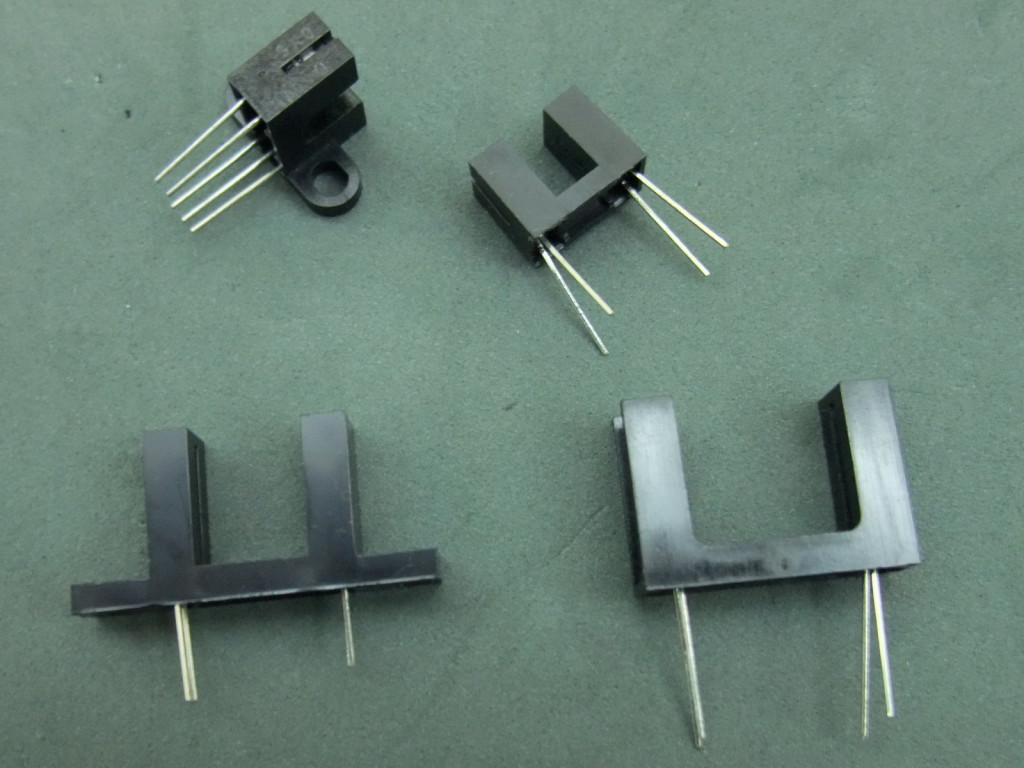
Photo interrupter

A photo interrupter has a LED at one side (normally IR) and a photo transistor at the other. When the LED in emitting light the photo transistor allows a current to flow. Remove the light and the current stops.
Read more

Photographing Water Drops: Second Go

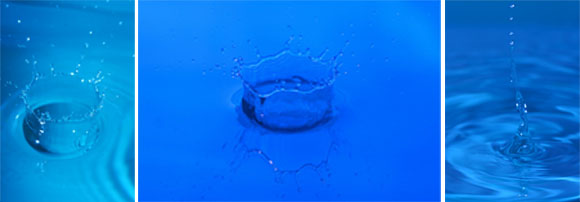
I had another session photographing water drops. The idea is to create two drops slightly apart. The first drop hits the water, rebounds and creates a column and then the second drop collides with the column. Sounds a lot easier than it really is. Here are some of the results. These are from plain water. … Read more

Controlling a Solenoid Valve from an Arduino

There is now an updated and more detailed post. See Controlling a Solenoid Valve from an Arduino. Updated.

 
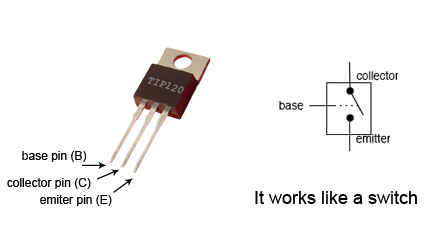
Using the Arduino to control the solenoid valve is simply a case of setting a pin high for the appropriate amount of time. There is, however, a caveat, the solenoid works at a different voltage to the Arduino and you cannot directly connect the two. In this case a TIP120 transistor is used as a bridge.

TIP120

The TIP120 allows a small dc voltage (from the Arduino) to switch a larger dc voltage (12V to the solenoid). It can be thought of as a switch, applying a current to  B allows current to flow between C to E.

Read more

Soleniod Valves

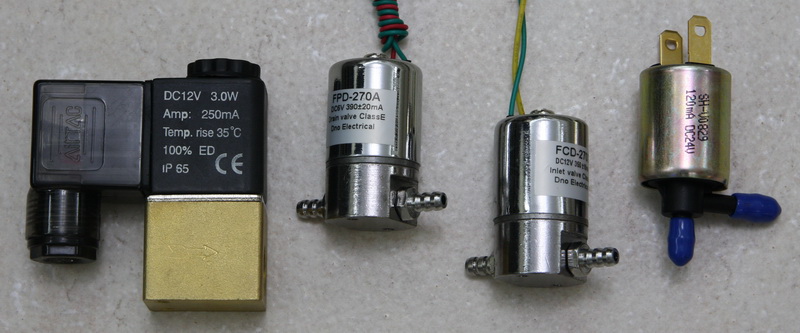
Solenoid valves are used to control the flow of liquids and gasses and they are an ideal way to create water drops. To get started I purchased a small range of different solenoids with the intention of testing them out and seeing which was the best. Solenoids

Read more

Using an Arduino and a optocoupler to activate a camera shutter

There are several ways you can connect an Arduino to a DSLR so that you can use the Arduino to activate the shutter. I chose to use an optocoupler, sometimes called an optoisolator.

Optocoupler

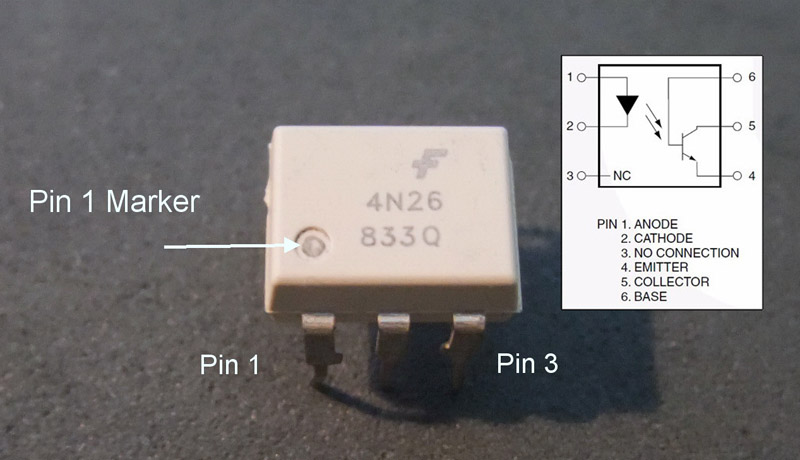
There are many types of optocoupler and you chose one based on the requirements of your circuit. My circuit is a 5V Arduino and a Canon 40D which has about 3.2V on the shutter release. Due to the relatively low voltages there are many suitable optocouplers to pick from. I already had a Fairchild 4N26 so this is the one I used.

4N26

4N26

Optocouplers are digital switches.  They work by using an LED emitter paired with a photo detector transistor. This means they can be used to allow one circuit to switch a separate circuit without having any electrical contact between the two. Basically, if you put a current through pins 1 and 2 and light the LED the photo detector transistor detects the light from the LED and allows a current to flow through pins 5 and 4. No current on pins 1 and 2 means current does not pass through pins 5 and 4.

Read more

Photographing Water Drops

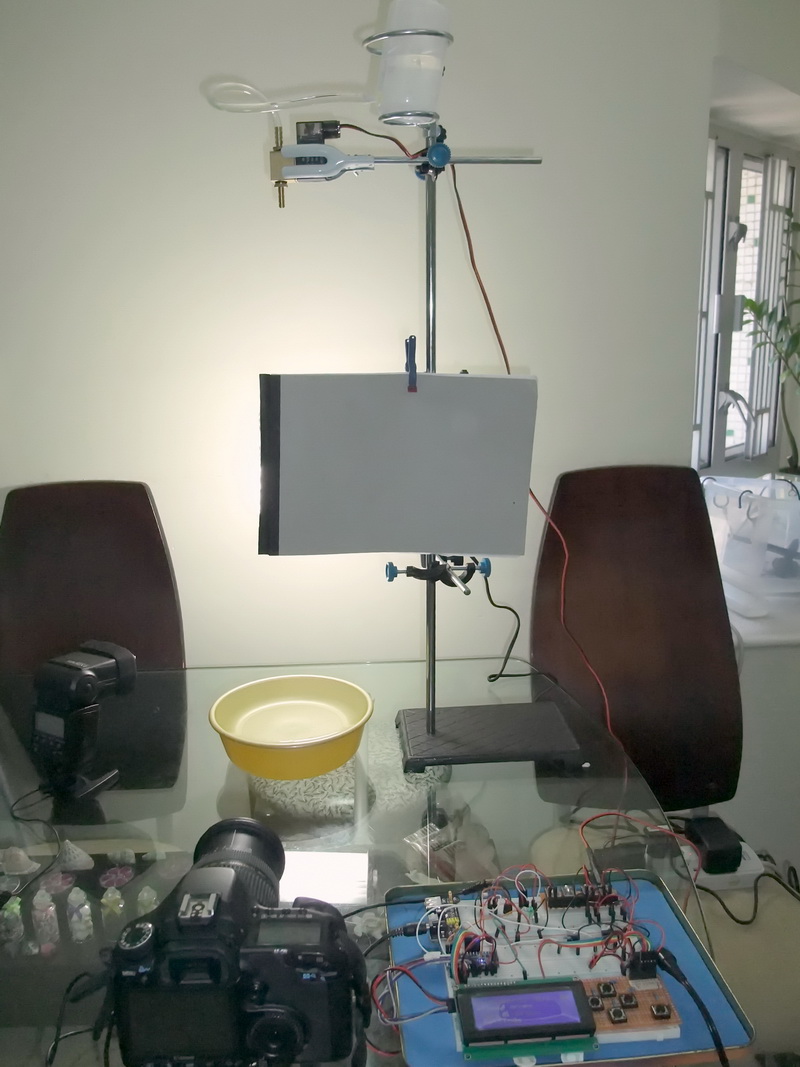
For quite a while I was looking at water drop photos and thinking about trying to do them myself. I finally gave it a go. My first try was simply making drops and trying to capture the splash. Everything was manual; the water drop, the shot, and it was very hit and miss. Mostly miss…

Early attempts at photographing water drops
I did get some shots I liked but these are nothing compared to the shots from other people.

When researching online it quickly became apparent I wasn’t going to get better shots with the setup I had; which was a plastic bag with a small hole and hitting the shutter release like a maniac.

Read more